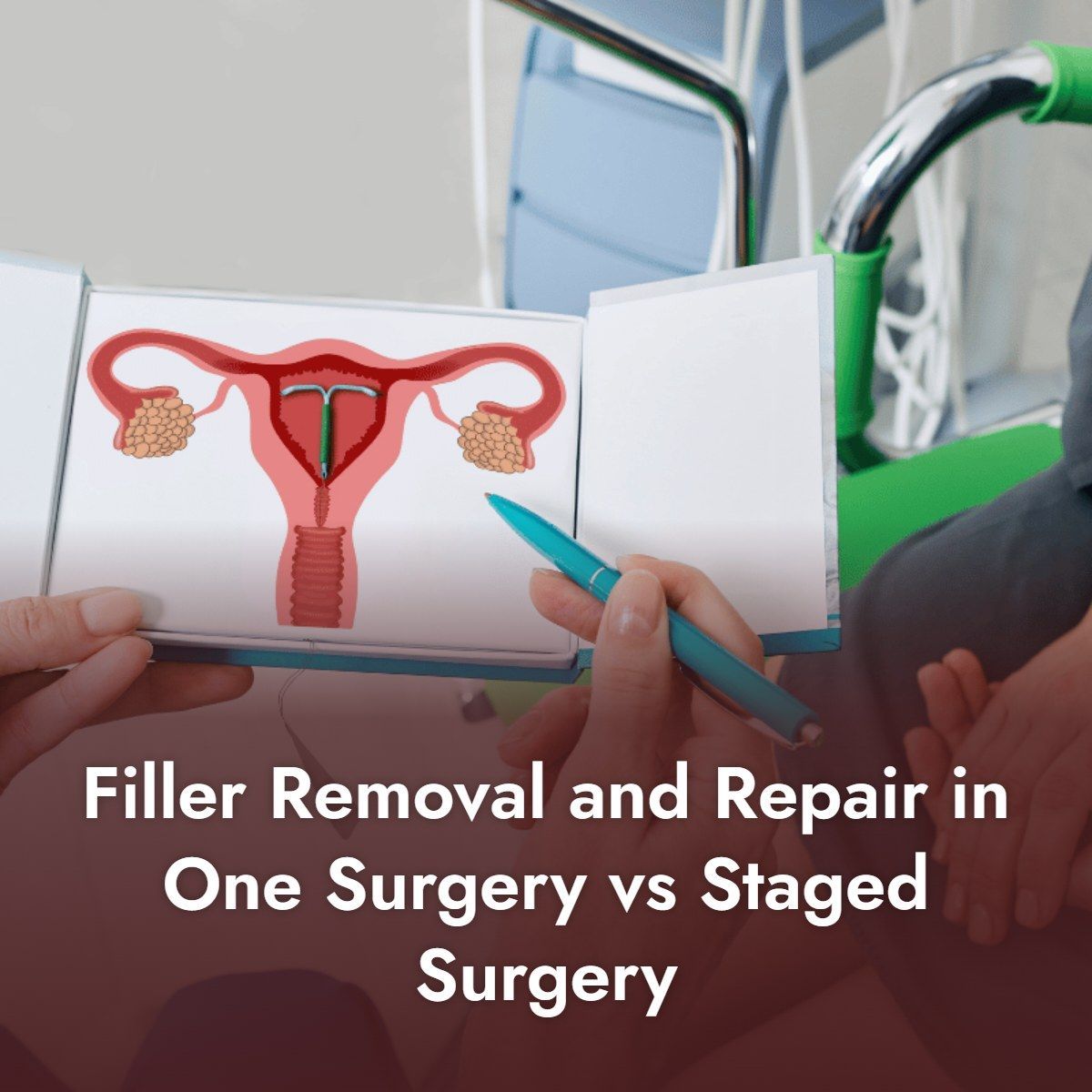
Removing problem filler and repairing the tissue in one surgery suits small, well-defined, non-infected deposits in healthy tissue, while staged surgery is usually safer when there is infection, widespread filler or poor tissue quality. In a staged plan, the filler is removed first and reconstruction follows once inflammation has settled. The right choice depends on filler type, imaging and the condition of the surrounding tissue.
Why genital filler sometimes needs to be removed
Fillers are injected into the labia majora, vaginal walls, clitoral hood or G-spot area to add volume or to tighten. Hyaluronic acid is temporary and can be dissolved. Other materials, including polyacrylamide gel, PMMA microspheres, liquid silicone and some unidentified products, can remain for years. Problems may appear soon after injection or long afterwards.
- Firm lumps, nodules or uneven contour.
- Migration of filler into nearby areas such as the perineum or buttocks.
- Recurrent swelling, redness or infection.
- Chronic pain or pain during intercourse.
- Granulomas, which are inflammatory reactions around foreign material.
- Draining sinuses or skin breakdown.
When filler is hyaluronic acid, an enzyme called hyaluronidase can often dissolve it without surgery. When the filler is permanent, unknown or has caused a chronic reaction, surgical removal is usually needed, and the question becomes whether to repair the area in the same operation.
Assessment before deciding on surgery
Planning begins with a careful history, ideally including records of what was injected, when and where. Many women do not know the product name, which is common after treatment abroad. An examination identifies lumps, scarring and skin quality, and imaging such as ultrasound or MRI shows how far the material has spread and whether there are abscesses or tracts. Swabs or cultures are taken if infection is suspected, and some surgeons request blood tests for inflammation.
This information shapes the plan more than any personal preference of the surgeon. A localised deposit seen clearly on imaging is a very different problem from filler scattered through several tissue planes.
What happens in a one-stage surgery?
In a single operation, the surgeon removes the filler and any affected capsule or granuloma tissue, washes the area, and immediately reconstructs the labia or vaginal wall. Reconstruction may involve closing tissue layers, reshaping the labia majora, or repairing the vaginal lining and supporting tissue.
The obvious advantages are one anaesthetic, one recovery period and, for women who travelled for surgery, one trip. The limitation is that repair is performed in tissue that may still be inflamed, scarred or contaminated, which can increase the risk of wound breakdown, infection and a poorer cosmetic result.
What happens in staged surgery?
In a staged approach, the first operation focuses on removing as much filler as is safely possible, draining any infection and allowing the area to heal. Reconstruction is planned for a later date, often several months afterwards, once swelling has settled and tissue has recovered. Sometimes the second stage is unnecessary because the tissue heals well on its own.
Staging adds a second procedure and a longer total timeline, but it allows the surgeon to judge the final shape on calm tissue and to deal with any residual filler first.
Side-by-side comparison
One-stage removal and repair
- Best suited to: small, well-mapped, non-infected deposits in otherwise healthy tissue.
- Anaesthetics: one.
- Total time to final result: shorter.
- Main advantage: convenience and a single recovery.
- Main drawbacks: higher chance of wound problems if tissue is inflamed; residual filler may be missed.
- Travel: fewer trips, but complications may still need local follow-up.
Staged removal then repair
- Best suited to: infection, abscess, extensive or migrated filler, permanent or unknown products, previous failed repair.
- Anaesthetics: usually two.
- Total time to final result: longer, often months.
- Main advantage: reconstruction on healed, assessable tissue.
- Main drawbacks: two recoveries, longer time with an altered appearance, more cost and time off work.
- Travel: may require two visits or a local surgeon for one stage.
Risks to understand with either approach
Removing filler is rarely as simple as lifting it out. Permanent gels and microspheres often intermingle with normal tissue, so complete removal can be impossible without taking healthy tissue too. Women should understand the following possibilities:
- Residual filler that continues to cause lumps or inflammation.
- Changes in sensation, including numbness near the clitoris or labia.
- Asymmetry or loss of volume once material is removed.
- Wound separation, infection or haematoma.
- Scarring that may cause tightness or pain with intercourse.
- The need for further surgery.
Recovery after removal is often longer and less predictable than after a first-time cosmetic procedure. Swelling can persist for weeks, and the final appearance may not be clear for several months. Women should plan for time off work, avoid intercourse and strenuous exercise until the surgeon confirms healing, and keep the area clean and dry. Persistent fever, spreading redness, increasing pain or discharge from the wound should be reported promptly.
Planning steps that improve outcomes
- Gather any records about the product, injection date and injector.
- Treat active infection first with appropriate antibiotics or drainage.
- Obtain imaging to map the filler before surgery.
- Agree in writing on what the first operation aims to achieve and what counts as success.
- Stop smoking and optimise conditions such as diabetes to support healing.
- Arrange follow-up, including who will see you if problems arise after you return home.
Which should you choose?
If imaging shows a limited, clean deposit and the surrounding tissue is healthy, one-stage removal and repair is a reasonable choice and spares a second anaesthetic. If there is infection, filler spread across several areas, a permanent or unknown product, or previous unsuccessful surgery, a staged plan is usually the safer option even though it takes longer.
Many surgeons keep an open mind during the operation: they plan for a single stage but stop after removal if the tissue looks unsuitable for immediate repair. Ask whether this is the plan, and agree in advance how that decision will be made and communicated.
Frequently asked questions
Can all genital filler be dissolved?
Only hyaluronic acid fillers respond to hyaluronidase. Permanent or semi-permanent materials, and filler of unknown type, generally need surgical removal if they cause problems.
Will all the filler be removed?
Not always. Some products infiltrate normal tissue, and removing every trace could cause more harm than benefit. The aim is usually to remove enough to relieve symptoms and restore a healthy shape.
How long should I wait between stages?
There is no single interval. Surgeons generally wait until infection has resolved, swelling has gone down and scars have softened, which often takes a few months.
Should I get filler again after removal?
It is wise to wait until healing is complete and to discuss whether further injections are necessary at all. If volume is needed later, options such as fat grafting or careful reconstruction may be considered.
References
- American College of Obstetricians and Gynecologists. Committee Opinion No. 795: Elective Female Genital Cosmetic Surgery. 2020.
- U.S. Food and Drug Administration. Dermal fillers (soft tissue fillers): safety information and warnings about injectable silicone for body contouring.
- Funt D, Pavicic T. Dermal fillers in aesthetics: an overview of adverse events and treatment approaches. Clinical, Cosmetic and Investigational Dermatology. 2013.
- Haylen BT, et al. An IUGA/ICS joint terminology and classification of complications related to prostheses and grafts in female pelvic floor surgery. 2011.
This article is for general education and does not replace an examination by a qualified gynecologist. Individual results vary, and every procedure carries risks.