
Vaginoplasty & Tightening · Treatment
Perineal Scar Revision After Episiotomy or Tearing in Seoul
Perineal scar revision removes painful, tight or lumpy scar tissue at the vaginal opening and perineum and closes the area with fine absorbable sutures so it heals soft and flat. Scars usually come from episiotomy, tearing during birth or a previous vaginal surgery that narrowed the entrance. At Somssi Women's Clinic in Gangnam, Seoul, Dr. Yoon Ho-joo combines scar release with widening or rebuilding the opening, using only your own tissue.
Medically reviewed by Dr. Yoon Ho-joo, MD, PhD, OB/GYN specialist, Somssi Women's Clinic · Last updated October 2026

At a glance
Key facts
The essentials, based on how Somssi Women's Clinic performs this procedure or answers this question. Your plan is confirmed at consultation.
- Procedure time: Under an hour; longer if combined with posterior repair
- Anesthesia: Local anesthesia, or sedation plus local for combined procedures
- Hospital stay: None; walk out the same day
- Back to work: Next day for desk work
- Intercourse: After 7–8 weeks for revision at the vaginal opening
- Sutures: Absorbable; dissolve in about 1 week
- Who it suits: Painful episiotomy or tear scars, scar bands narrowing the entrance, chronic wounds at the opening after earlier surgery
Perineal scar revision at a glance
Removes painful, tight or lumpy scar at the opening and perineum after episiotomy, tearing or earlier surgery.
- perineal scar revision
- episiotomy scar pain
- painful scar after birth
- vaginal opening scar
- tear scar repair Korea
- pain with intercourse after childbirth
- Under 1 hourProcedure time
- Local or sedationAnesthesia
- Same dayDischarge
- After 7–8 weeksIntercourse
- Find the scarPainful bands and nodules mapped.
- ExciseScar tissue removed.
- Close softlyFine absorbable sutures, flat healing.
- RecoverDesk work the next day.
Illustration: Somssi Women's Clinic, Seoul. Schematic, not to scale; your plan is set by Dr. Yoon Ho-joo after examination.
What is perineal scar revision?
Perineal scar revision is the surgical correction of scar tissue at the vaginal entrance and perineum, the area between the vagina and the anus. Scars here form after an episiotomy, a tear during childbirth, or a previous vaginal operation that was closed under tension or removed too much tissue. When the scar is thick, tethered or forms a tight ridge across the opening, it can make intercourse painful, catch and crack repeatedly, or leave the entrance smaller than the canal behind it.
Scar problems at the perineum are common. Most first vaginal births involve some tearing or an episiotomy, and while the majority heal without trouble, a scar that is closed under tension, becomes infected, or is simply thick by nature can stay symptomatic for years. Many women put up with it because they assume nothing can be done.
The revision removes the scar, releases any band that is narrowing the opening, and closes the area in layers with fine absorbable sutures so that the new line heals soft. Somssi Women's Clinic is a surgical gynecology clinic in Gangnam, Seoul, founded in 2000 and led by Dr. Yoon Ho-joo, MD, PhD, and scar revision is one part of its revision program for women who have had vaginal or perineal surgery elsewhere.
Who is a good candidate?
- An episiotomy or tear scar that is tender, pulls or burns during intercourse
- A hard lump or ridge at the back of the vaginal opening
- A "chin-like" band of scar across the entrance after a previous tightening operation
- A small crack or wound at the opening that keeps reopening with intercourse or exercise
- An entrance that has become too narrow after surgery elsewhere, while the inside still feels loose
- Thin, fragile perineal skin after menopause that tears easily
If the problem is not scar but a genuinely wide or short perineum, perineoplasty is the right operation. If the whole entrance is narrowed rather than just a scar band, see our page on vaginal stenosis. Dr. Yoon will tell you which applies after examination; sometimes a revision is combined with one of these.
How Somssi performs perineal scar revision
Looking beyond the scar
A scar at the entrance is often only the visible part of a problem. Many women who come for revision after surgery elsewhere have an opening that was narrowed by a triangular or diamond-shaped excision while the upper vagina was never treated. Dr. Yoon therefore examines the whole canal, measures its length and width, and checks the pelvic floor, uterus and perineal body before planning anything.
Excision and release
The scar is marked and excised conservatively, taking only the fibrous tissue. Where a band is pulling the opening tight, it is released so the entrance can be sized to match the canal. Skin and mucosa are handled with fine instruments, following the clinic's principle of the minimum surgical scope needed for the effect.
Layered closure with your own tissue
The underlying perineal muscle is re-approximated if it has separated, and the mucosa and skin are closed in separate layers with absorbable sutures so that the wound is not under tension. Where the muscle ring at the opening is weak, the clinic's figure-8 reinforcement of the pubococcygeus muscles can be added. No mesh, implants or fillers are used.
Combining with other repair
If the inside of the vagina is loose, a scar revision alone will not help you feel better, and Dr. Yoon may recommend adding a posterior colporrhaphy in the same session. If the entrance is too small overall, an opening expansion is performed as part of the revision.
Anesthesia, duration and hospital stay
A simple scar revision can be performed under local anesthesia in well under an hour. When it is combined with posterior repair or opening expansion, sedation plus long-acting local anesthesia is used and the session lasts about an hour. A non-narcotic anti-inflammatory injection is given at the end. There is no hospital stay; you walk out and are discharged once you have urinated. Fast for 2 hours beforehand if sedation is planned.
Recovery timeline
| When | What you can do |
|---|---|
| Same day | Shower, walk, go home |
| Days 1–5 | Desk work and daily life; medication for about 5 days; keep stools soft |
| About 1 week | Sutures dissolve; light sport |
| 6 weeks | Vigorous exercise, bathing, sauna |
| 7–8 weeks | Intercourse, once the new scar is soft and pain-free |
Keep the area clean with a daily shower and avoid tight clothing and cycling until the skin has healed. Follow-up can be managed by photograph or video for patients abroad.
After using the toilet, rinse with warm water and pat dry. Wear loose cotton underwear and avoid prolonged sitting on hard surfaces for the first week. Showering from day one is encouraged; soaking in a bath, swimming and saunas wait until six weeks so the wound stays dry between washes.
Results and what to expect
The aim is an entrance that is comfortable, supple and the same size as the canal behind it, with a fine, flat scar line rather than a ridge. Most women find that the localized pain, catching and recurrent cracking resolve once the fibrous tissue is gone and the wound has healed without tension.
Results vary. Scar tissue forms as part of normal healing, and a small number of women form thicker scars whatever the technique. Revision also cannot restore sensation lost to nerve damage from an earlier operation, although releasing a tight band often makes intercourse far more comfortable. Your result is reviewed at around eight weeks.
Before surgery, bring any operation notes or photographs from the earlier procedure if you have them. Knowing exactly what was removed or placed helps Dr. Yoon plan the revision and set realistic expectations with you.
Risks and how we reduce them
Risks include bleeding, infection, wound separation, a new scar that is itself thick or tender, asymmetry, over- or under-correction of the opening, altered sensation and, rarely, injury to the rectum when the scar lies deep in the perineal body. Local and sedation anesthesia carry their own small risks.
We reduce these risks by excising only fibrous tissue, closing in layers without tension, using fine absorbable sutures and no foreign material, and by addressing any looseness behind the scar so the entrance is not asked to do the canal's job. Clear hygiene and bowel-care instructions reduce the chance of infection and separation.
Why international patients choose Somssi
Women who have had unsatisfactory surgery elsewhere make up a growing share of the clinic's patients, and revision is approached with a full assessment rather than a quick fix. Somssi has been a Ministry of Health and Welfare registered institution for foreign patients since 2011, offers English consultations and same-day discharge, and is 100 meters from Gangnam Station Exit 1. Visit our international patients page or contact us with photographs or a description of your concern.
Private consultation
Talk it through with Dr. Yoon's team
English-speaking coordinators, a written treatment plan and a clear quote after your consultation. Same-day discharge for most procedures.
Mon, Tue, Wed, Fri, Sat 09:30–18:00 (KST). Closed Thu, Sun and holidays. 7F Sangkyung Building, 120 Teheran-ro, Gangnam-gu, Seoul.
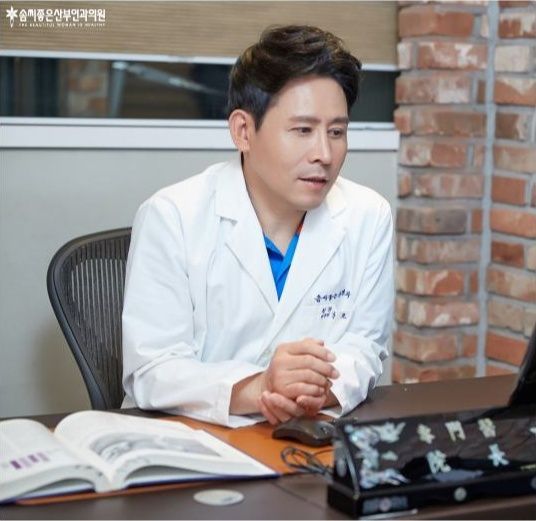
Dr. Yoon Ho-joo, MD, PhD
OB/GYN specialist, Catholic University of Korea. Founder of Somssi Women's Clinic (2000). Published on female sexual function after reconstructive vaginal surgery; speaker at ESSM, ISSWSH, WAS and SMSNA.
Questions patients ask
Frequently asked questions
Short, honest answers. For anything personal, a consultation is the right place to ask.
Why does my episiotomy scar still hurt years later?
Scar tissue is less elastic than normal skin and mucosa, so a scar across the vaginal opening is stretched every time the entrance opens. If the scar is thick, tethered to the muscle beneath, or contains a small nerve caught in the fibrous tissue, it can stay tender for years. Revision removes the fibrous tissue and closes the area without tension so it can heal soft.
Can scar revision widen an opening that was made too tight?
Yes. When a previous operation removed too much tissue at the entrance, a band of scar often forms that narrows the opening to less than the canal behind it. Releasing and excising that band, and expanding the opening to match the inside, is a routine part of the clinic's revision program. If the inside is loose at the same time, both problems are corrected together.
Will the revision leave a new scar?
Any incision heals with a scar, but a fine line closed in layers without tension is usually flat, pale and painless, which is very different from a thick ridge. A small number of women form prominent scars regardless of technique; tell Dr. Yoon if you have a history of keloids so the plan and expectations can be adjusted.
Can I have scar revision under local anesthesia?
A simple scar revision at the perineum can be done under local anesthesia, and many patients prefer it. If the revision is combined with posterior repair or widening of the opening, sedation with long-acting local anesthesia is more comfortable. Both options allow you to walk out the same day.
How is this different from perineoplasty?
Scar revision removes and re-closes abnormal scar tissue. Perineoplasty rebuilds the whole perineal body when it is short, thin or gaping, re-approximating the muscles and lengthening the distance between vagina and anus. A revision is smaller and focused on the scar; a perineoplasty restores structure. Dr. Yoon decides which you need after examining the perineum and the canal.
Keep reading
Related treatments and guides
- Perineoplasty — for a perineum that is short or gaping, not just scarred
- Vaginal Stenosis — when the whole entrance or canal has narrowed
- How Long Does Vaginoplasty Recovery Take? — the shared healing schedule for surgery at the opening
- Is Vaginoplasty in Korea Safe? — risks of surgery at the vaginal entrance
- Vaginoplasty After Childbirth: Can Surgery Repair Vaginal Laxity? — when looseness lies behind the scar
- Labiaplasty Revision — correcting unsatisfactory labial surgery
- International Patients — sending photographs and planning a visit
Sources and medical review
- Te Linde's Operative Gynecology (textbook), perineal repair and management of obstetric lacerations.
- American College of Obstetricians and Gynecologists (ACOG), guidance on prevention and management of obstetric lacerations.
- Yoon H.J. Perineal plastic surgery (colpoperineoplasty) and female sexual function. Korean Journal of Obstetrics and Gynecology, vol. 48, no. 6, 2005.
Next step
A consultation first. A decision only when you are ready.
Tell us what you are experiencing and what you hope to change. Dr. Yoon examines, measures and explains the options, including when no surgery is the right answer. International patients can start with an online consultation before travelling to Seoul.
