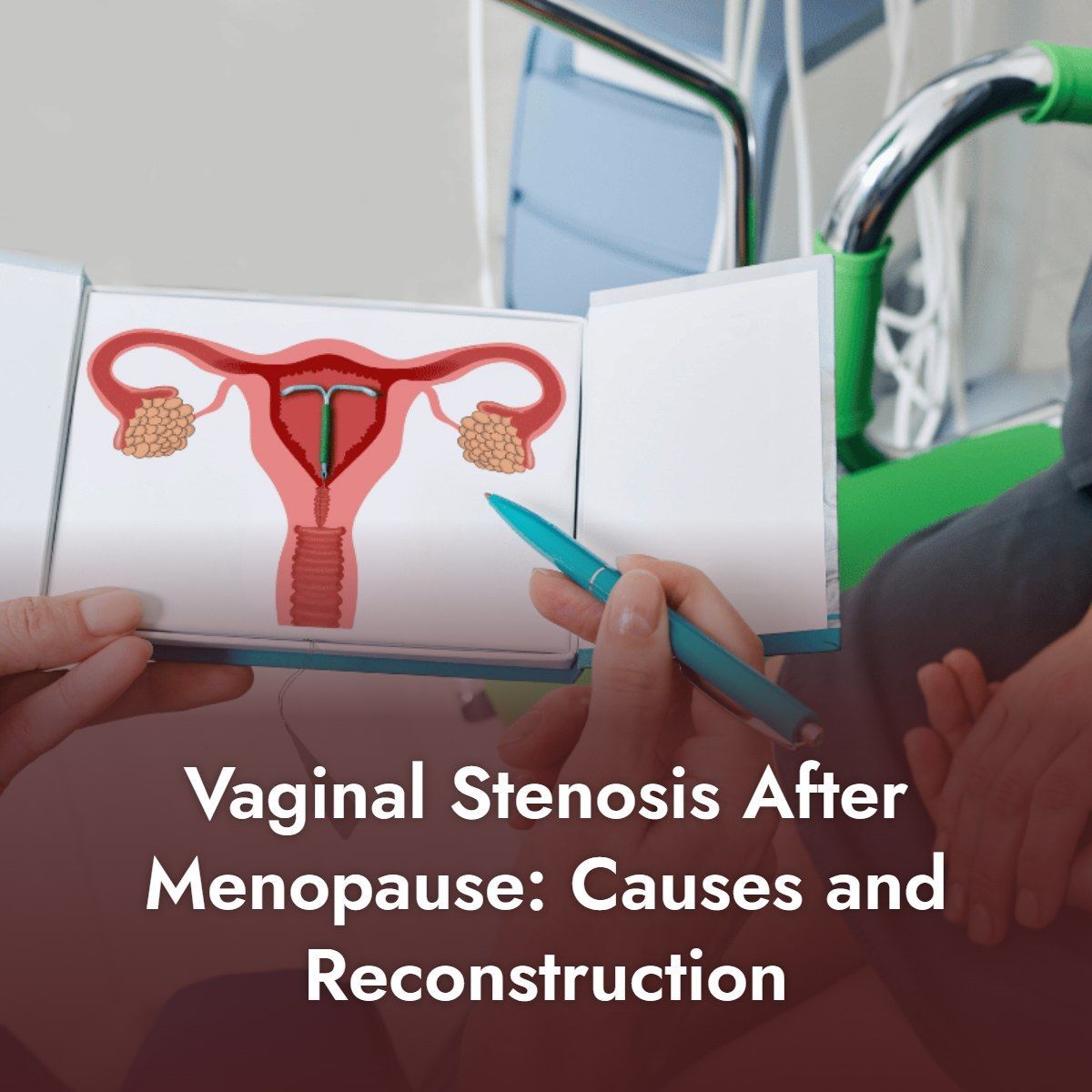
Vaginal stenosis after menopause is a narrowing or shortening of the vagina, most often caused by low estrogen, combined in some women with scarring from surgery, radiation or skin conditions such as lichen sclerosus. Many cases improve with local hormone therapy, moisturizers and graduated dilators. Surgical reconstruction is reserved for fixed scar bands or severe narrowing that does not respond.
What vaginal stenosis means after menopause
Stenosis describes a vagina that has become narrower, shorter or less elastic than before. It can affect the entrance (introital stenosis), the upper vagina near the cervix or vaginal vault, or the whole canal. Women usually notice it as pain or a blocking sensation during intercourse, difficulty inserting a tampon or speculum, bleeding after sex, or the feeling that penetration is no longer possible.
After menopause, falling estrogen thins the vaginal lining, reduces blood flow and natural lubrication, and makes the tissue less stretchy. Doctors now group these changes under the term genitourinary syndrome of menopause (GSM). Stenosis sits at the more advanced end of this spectrum, where the tissue has not just thinned but physically contracted.
Common causes and risk factors
Several factors often act together. The most frequent contributors include:
- Estrogen deficiency: natural menopause, surgical removal of the ovaries, or medicines that block estrogen, such as aromatase inhibitors used after breast cancer.
- Long periods without vaginal penetration: tissue that is not regularly stretched tends to shrink, especially after menopause.
- Previous pelvic surgery: hysterectomy, prolapse repair or posterior wall tightening can shorten or narrow the canal, sometimes only becoming obvious years later.
- Pelvic radiation: radiotherapy for cervical, endometrial or rectal cancer can cause progressive fibrosis.
- Inflammatory skin conditions: lichen sclerosus mainly affects the vulva and can narrow the entrance, while erosive lichen planus can scar the vagina itself.
- Obstetric or perineal scarring: old tears or an episiotomy repair that become tighter as tissue loses estrogen.
Symptoms that suggest more than ordinary dryness
Dryness and mild discomfort are common after menopause and usually respond to simple measures. Stenosis is more likely when there is a tight ring or band at the entrance, a distinct point where a finger or speculum cannot pass, a vagina that feels clearly shorter, or tearing and bleeding with gentle attempts at penetration. Some women avoid sex altogether, which can then make the narrowing progress further. Recurrent urinary infections and urinary urgency may also appear, since the urethra and bladder share the same estrogen-sensitive tissue.
How the condition is assessed
An examination should be gentle and unhurried, sometimes starting with a single finger or a narrow speculum. The gynecologist measures how wide and deep the vagina is, looks for scar bands, and checks the vulvar skin for whitening, cracking or loss of the normal architecture that may indicate lichen sclerosus. A biopsy is taken if any area looks suspicious. In women with prior cancer, the examination also serves as surveillance, so any new nodule or bleeding is investigated rather than assumed to be scarring.
Non-surgical treatment comes first
Most postmenopausal stenosis, particularly when it results from atrophy rather than dense scarring, improves without surgery. A typical step-by-step plan looks like this:
- Start regular vaginal moisturizers several times a week and use a lubricant during any penetration.
- Begin low-dose vaginal estrogen as a cream, tablet or ring, unless there is a specific reason to avoid it. Alternatives include vaginal prasterone (DHEA) and the oral medicine ospemifene.
- Treat any skin disease, for example a potent topical steroid for lichen sclerosus, before or alongside stretching.
- After a few weeks of tissue preparation, use vaginal dilators of gradually increasing size, typically for 10 to 15 minutes several times a week.
- Work with a pelvic floor physical therapist if muscle guarding or pain makes dilation difficult.
- Reassess after several months to judge whether the remaining narrowing is soft and improving or fixed and fibrotic.
Local estrogen therapy is supported by Cochrane evidence for relieving vaginal atrophy symptoms, and very little hormone is absorbed into the bloodstream at standard doses. Women with a history of estrogen-sensitive breast cancer should make this decision together with their oncology team. Laser and radiofrequency devices are sometimes promoted for vaginal atrophy, but regulators have warned that their safety and effectiveness for these uses have not been established, so they should not be presented as a substitute for proven treatment.
When reconstruction is considered
Surgery is reasonable when narrowing is caused by firm scar tissue that has not responded to an adequate trial of estrogen and dilators, when a band at the entrance tears repeatedly, or when the vagina is so short or closed that examinations and cancer surveillance are impossible. The choice of operation depends on where the narrowing is and how much healthy tissue is available.
- Scar release with re-closure: a tight ring at the entrance can be cut vertically and closed horizontally, widening the opening; a version of this is known as the Fenton procedure.
- Z-plasty or local flaps: rearranging nearby tissue lengthens or widens a contracted band without adding tension.
- Excision of scar after previous repairs: removing a tight ridge left by earlier prolapse or posterior wall surgery.
- Grafts or larger flaps: for severe stenosis, especially after radiation, the canal may be reopened and lined with a skin graft or a flap, followed by prolonged dilator use.
Recovery and keeping the result
Healing after a simple release usually takes a few weeks, while graft or flap procedures need longer recovery. The most important factor for a lasting result is continued use of vaginal estrogen, where appropriate, and regular dilators or intercourse once healed. Without ongoing stretching, scar tissue can contract again. Risks include bleeding, infection, poor wound healing, recurrent narrowing and, rarely, injury to the bladder or rectum.
Living with and preventing recurrence
Prevention is easier than reversal. Women approaching or past menopause who notice early dryness or discomfort benefit from treatment before narrowing becomes fixed. After pelvic radiation, many cancer centers recommend starting dilators once acute inflammation settles, although the strength of evidence for this practice is limited. Open communication with partners and with the gynecologist matters, because pain and avoidance can create a cycle that worsens both the physical and emotional side of the problem.
Frequently asked questions
Can vaginal stenosis after menopause be reversed?
Mild to moderate narrowing caused by atrophy often improves substantially with local estrogen, moisturizers and gradual dilation. Dense scarring is less likely to respond fully and may need surgery.
Is vaginal estrogen safe for long-term use?
For most women, low-dose vaginal estrogen is considered safe with minimal absorption. Women with a history of breast or endometrial cancer should discuss the balance of benefits and risks with their specialists.
How long do I need to use dilators?
Usually for several months, and often indefinitely at a lower frequency to maintain the result. Regular intercourse can serve the same purpose for some women.
Does surgery guarantee comfortable intercourse?
No. Surgery can restore width and depth, but comfort also depends on tissue quality, lubrication, pelvic muscle relaxation and ongoing maintenance. Many women improve, though results vary.
Can a narrowed vagina hide cancer?
Narrowing itself is not cancer, but it can make examination difficult. Any bleeding, discharge or new lump after menopause should be checked promptly.
References
- Portman DJ, Gass ML; Vulvovaginal Atrophy Terminology Consensus Conference Panel. Genitourinary syndrome of menopause: new terminology for vulvovaginal atrophy. Menopause and Maturitas, 2014.
- The North American Menopause Society. The 2020 genitourinary syndrome of menopause position statement. Menopause, 2020.
- Lethaby A, Ayeleke RO, Roberts H. Local oestrogen for vaginal atrophy in postmenopausal women. Cochrane Database of Systematic Reviews, 2016.
- Miles T, Johnson N. Vaginal dilator therapy for women receiving pelvic radiotherapy. Cochrane Database of Systematic Reviews, 2014.
- U.S. Food and Drug Administration. Statement and safety communication on the use of energy-based devices for vaginal rejuvenation, 2018.
This article is for general education and does not replace an examination by a qualified gynecologist. Individual results vary, and every procedure carries risks.