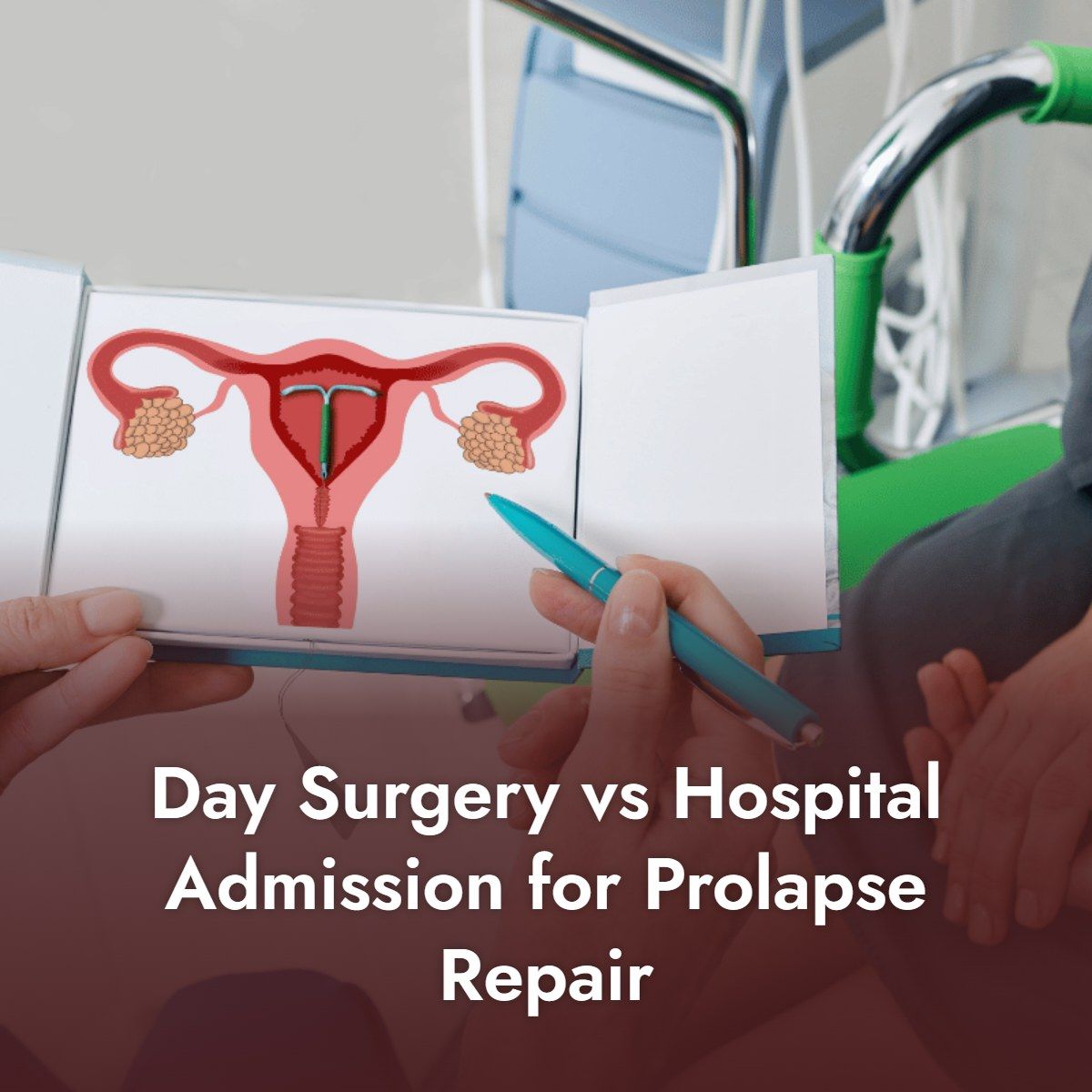
Many prolapse repairs can now be done as day surgery, with discharge the same day, while others still need one or more nights in hospital. The right choice depends on the type of operation, your general health, how well you pass urine afterwards and the support you have at home. Safety, not convenience alone, should decide.
What is the difference between day surgery and hospital admission?
Day surgery (also called ambulatory or same-day surgery) means you arrive, have the operation and go home on the same day, usually after a few hours of recovery and checks. Hospital admission means staying at least one night, and sometimes two or more, so that nurses can monitor pain, bleeding, bladder function and mobility.
A middle option, often called a "23-hour stay" or short-stay admission, keeps you overnight and discharges you the next morning. Many vaginal prolapse repairs fall into this category.
Over the past two decades, enhanced recovery programs have shortened hospital stays across gynecologic surgery. These programs combine careful anesthesia, early eating and drinking, early walking and good pain control with fewer opioids. As a result, same-day discharge after pelvic floor surgery has become more common in many countries.
Which prolapse operations are often done as day surgery?
Operations that are shorter, involve less tissue dissection and cause less bleeding are more often suitable for same-day discharge. Examples include:
- Anterior repair (for a cystocele) or posterior repair (for a rectocele) on their own
- Perineal repair (perineorrhaphy)
- Colpocleisis in carefully selected older women
- Some sacrospinous fixations and uterus-sparing vaginal procedures, depending on local practice
Operations that are longer or combined are more often managed with an overnight stay:
- Vaginal hysterectomy with apical suspension and front and back wall repairs
- Laparoscopic or robotic sacrocolpopexy or sacrohysteropexy, although some centers discharge these the same day
- Open abdominal procedures, which usually need several nights
- Any repair combined with a continence operation where bladder emptying is a concern
Day surgery vs hospital admission: side-by-side comparison
These general differences help frame the discussion with your surgeon.
Day surgery
- Time in hospital: several hours
- Typical candidates: healthy women having a single, shorter repair
- Anesthesia: general or spinal, with short-acting drugs to allow early walking
- Bladder: you must usually pass urine adequately, or go home with a catheter
- Advantages: sleeping in your own bed, lower risk of hospital-acquired infection, often less disruption
- Drawbacks: less nursing support overnight; you need a responsible adult at home
Hospital admission
- Time in hospital: one to several nights
- Typical candidates: longer or combined operations, older women, those with heart, lung or blood-clotting conditions
- Anesthesia: any type, with more flexibility for longer-acting pain relief
- Bladder: more time to recover normal emptying before going home
- Advantages: close monitoring of bleeding, pain and urination; help with walking
- Drawbacks: unfamiliar environment, possible sleep disruption, often greater cost and time away from home
Who is a good candidate for same-day discharge?
Being suitable for day surgery is about overall risk, not just the operation itself. Surgeons and anesthetists generally look for:
- Good general health, or well-controlled long-term conditions
- No major history of complications with anesthesia
- A stable home environment with an adult who can stay for at least the first night
- Reasonable travel distance to a hospital in case of problems
- Willingness and ability to follow instructions about pain relief, bladder care and warning signs
Factors that often favor an overnight stay include significant heart or lung disease, obstructive sleep apnea, poorly controlled diabetes, a history of blood clots, living alone, or a long journey home. International patients who are staying in a hotel may also benefit from more conservative planning.
What happens on the day of surgery?
The pathway is similar whether or not you stay overnight. A typical sequence is:
- Pre-operative assessment, often days earlier, to review health, medicines and blood tests.
- Fasting according to anesthesia instructions, then arrival at the hospital.
- The operation, which for a single vaginal repair often takes around an hour.
- Recovery room monitoring of breathing, blood pressure, pain and nausea.
- A voiding trial, in which your bladder is filled or you are asked to pass urine, and the amount left behind is measured.
- Discharge if you are walking, eating, comfortable on tablets and emptying your bladder well; otherwise, admission overnight.
A vaginal pack and urinary catheter are sometimes left in place for a few hours or overnight. Policies vary, and this is one reason some repairs are planned as short-stay admissions.
Is going home the same day safe?
For well-selected patients having suitable operations, published studies in urogynecology suggest that same-day discharge is generally safe and does not appear to increase serious complications or readmissions compared with an overnight stay. Patient satisfaction is often high. However, the evidence comes mainly from experienced centers with structured pathways, and results may not apply everywhere.
The most common reason a planned day case becomes an admission is difficulty emptying the bladder. Some women go home with a temporary catheter or learn to self-catheterize for a few days. Others stay for pain control, nausea or drowsiness after anesthesia.
Whichever pathway you follow, know the warning signs that need urgent review:
- Heavy vaginal bleeding or passing large clots
- Fever, chills or foul-smelling discharge
- Inability to pass urine or worsening abdominal pain
- Calf pain or swelling, chest pain or breathlessness
Which should you choose?
Usually the decision is shared between you, your surgeon and the anesthetist. Day surgery is reasonable if you are healthy, the planned operation is a single vaginal repair, and you have reliable support at home. Planned overnight admission is sensible if you are having a combined or laparoscopic procedure, have significant medical conditions, live alone or far away, or would simply feel safer with nursing care for the first night.
Remember that the length of your hospital stay does not change how long the repair itself takes to heal. Internal healing still takes around six weeks, and protecting the repair from heavy lifting and straining matters more than where you sleep on the first night.
Frequently asked questions
Will I need a catheter if I go home the same day?
Not always. Most women pass urine normally before discharge. If the bladder does not empty well, you may go home with a temporary catheter for a few days or be taught self-catheterization, and the bladder usually recovers.
Does a shorter hospital stay mean a faster recovery?
Not necessarily. Day surgery mainly shortens the time spent in hospital. Tissue healing, return to exercise and sexual activity follow similar timelines in both pathways.
Can international patients have day-case prolapse surgery?
It may be possible, but surgeons often advise a more cautious plan, such as an overnight stay and accommodation near the hospital for the first week. A follow-up examination before flying home is also usually recommended.
What if I am not ready to go home on the planned day?
A planned day case can be converted to an overnight admission at any time if pain, nausea, bleeding or bladder emptying is not satisfactory. This is a normal safety step, not a sign that something has gone wrong.
References
- American College of Obstetricians and Gynecologists and American Urogynecologic Society. Practice Bulletin No. 214: Pelvic Organ Prolapse. Obstetrics and Gynecology, 2019.
- Nelson G, et al. Guidelines for perioperative care in gynecologic/oncology: Enhanced Recovery After Surgery (ERAS) Society recommendations, 2019 update. International Journal of Gynecological Cancer, 2019.
- National Institute for Health and Care Excellence (NICE). Urinary incontinence and pelvic organ prolapse in women: management (NG123), 2019.
- Haylen BT, et al. An International Urogynecological Association (IUGA)/International Continence Society (ICS) joint report on the terminology for female pelvic organ prolapse. International Urogynecology Journal, 2016.
This article is for general education and does not replace an examination by a qualified gynecologist. Individual results vary, and every procedure carries risks.