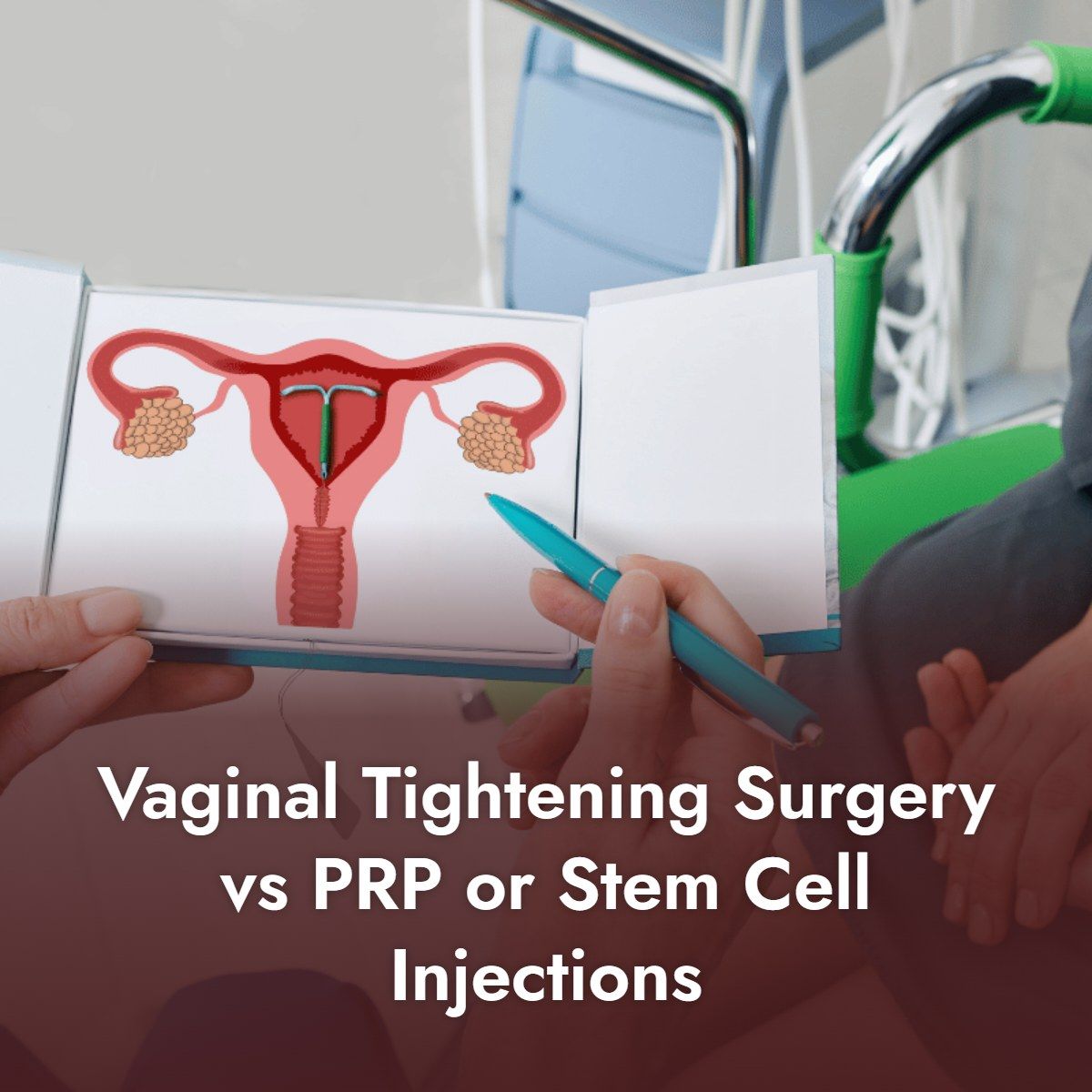
Vaginal tightening surgery physically rebuilds stretched muscle and tissue, while PRP and stem cell injections aim to improve tissue quality without changing anatomy. Surgery has a clearer, more lasting effect on true laxity but involves a real recovery. Injections are quick and low-downtime, yet evidence for tightening is limited and largely experimental, so expectations should be modest.
Why women seek vaginal tightening
The sensation of vaginal looseness, often called vaginal laxity, is most commonly linked to childbirth, aging and the drop in estrogen around menopause. Women may notice reduced friction during sex, air entering the vagina, a wider-looking entrance or a feeling that tampons do not stay in place. Laxity can coexist with prolapse or bladder leakage, so a careful pelvic examination matters before choosing any treatment.
Two very different categories of treatment are marketed for this problem:
- Surgical repair, such as perineoplasty and posterior colporrhaphy, often described as vaginoplasty
- Regenerative injections, mainly platelet-rich plasma (PRP) and, less commonly, cell-based products described as stem cell or fat-derived treatments
How vaginal tightening surgery works
Surgery addresses structure. The surgeon removes a strip of excess lining, usually along the back wall, and brings the separated muscles and connective tissue back together. The perineal body, the firm area between the vagina and anus that is often torn or stretched in childbirth, is rebuilt to narrow the entrance and restore support. The result is a measurably narrower canal and firmer opening.
How PRP and stem cell injections work
PRP is made by drawing your blood and spinning it to concentrate platelets, which release growth factors. The concentrate is injected into the vaginal wall or around the clitoris. The theory is that growth factors stimulate collagen, blood flow and tissue repair. So-called stem cell treatments usually involve fat taken by liposuction, processed and injected into the vaginal tissue; the fat itself adds volume and may contain regenerative cells. Neither approach repairs separated muscles or a damaged perineal body.
Surgery vs injections: side-by-side comparison
Vaginal tightening surgery
- How it works: excess lining is removed and the underlying muscles and perineal body are repaired and tightened.
- Results: a visible and physical narrowing of the canal and entrance; most women in published series report improved sensation of tightness and sexual satisfaction, though data quality is mixed.
- Durability: long-lasting, often many years, although a further vaginal birth and aging can stretch tissues again.
- Recovery: one to two weeks of swelling and discomfort, avoidance of heavy lifting, and no intercourse for around six to eight weeks.
- Risks: bleeding, infection, poor wound healing, scarring, overly narrow entrance and painful intercourse, and rarely injury to the rectum.
- Who it suits: women with clear muscular or perineal laxity, often after childbirth, who have finished having children and accept a surgical recovery.
PRP or stem cell injections
- How it works: concentrated platelets or processed fat are injected to try to stimulate tissue regeneration and blood flow.
- Results: some small studies report improved lubrication, sensation or mild genitourinary symptoms; good evidence for meaningful tightening is lacking.
- Durability: uncertain; effects, when noticed, often fade within months and repeat sessions are commonly suggested.
- Recovery: minimal; mild soreness or spotting for a day or two, with return to normal activity quickly.
- Risks: pain, bruising, infection, and for fat transfer, liposuction risks, lumps or uneven absorption; cell-based products carry additional regulatory and safety uncertainty.
- Who it suits: women with mild symptoms who want a low-downtime option, understand that it is unproven for tightening and are not seeking a structural change.
What does the evidence say?
Professional bodies have been cautious about both categories. Gynecologic organizations have stated that cosmetic vaginal procedures lack strong evidence and that women should be counseled about uncertain benefit and possible harm. Regulators have warned that energy-based and regenerative treatments marketed for vaginal rejuvenation have not been established as safe and effective for those uses. Stem cell products in particular are tightly regulated in many countries, and unapproved cell treatments have caused serious harm in other body areas.
For surgery, much of the data comes from case series without control groups. Even so, the anatomical change is real and measurable, which is why surgery is generally considered the more predictable option for marked laxity.
How to decide what you need
A structured approach helps avoid paying for a treatment that cannot fix your problem:
- Describe your symptoms precisely: looseness during sex, visible gaping, air or water entering, leakage or a bulge.
- Have a pelvic examination to assess the perineum, muscle strength and any prolapse.
- Try pelvic floor muscle training under guidance, which improves tone for many women and costs little.
- Treat contributing factors such as vaginal dryness from low estrogen, which local estrogen can help.
- Consider surgery if a structural defect is clear and symptoms persist; consider injections only with realistic expectations and clear information on the product used.
Can the two approaches be combined?
Some practitioners offer injections after surgery in the hope of improving healing or tissue quality. There is little evidence that this improves outcomes. If combination treatment is suggested, ask what benefit is expected, what the evidence is and whether the cost is justified.
It also helps to separate tightening from other goals. If your main concern is dryness or pain with intercourse after menopause, low-dose vaginal estrogen or moisturizers have far better evidence than either injections or surgery, and they may resolve much of what feels like looseness.
Which should you choose?
Choose surgery if you have obvious stretching of the entrance or back wall, have completed childbearing and want a lasting physical change. Consider injections only if your symptoms are mild, you value minimal downtime and you accept that results are uncertain and possibly temporary. Many women benefit most from starting with pelvic floor training and treating dryness, then reassessing.
Frequently asked questions
Does PRP tighten the vagina?
There is no strong evidence that PRP produces true tightening. Small studies suggest possible improvements in lubrication or sensation, but they are limited in size and design. PRP does not repair separated muscles or a stretched perineal body.
Are stem cell vaginal treatments approved?
In many countries, processed cell products are regulated as medicines and are not approved for vaginal rejuvenation. Fat grafting without extensive processing is treated differently. Ask exactly what is being injected and what approval it has.
How long do surgical results last?
Results are generally long-lasting. Another vaginal delivery, significant weight change or aging can reduce the effect over time. That is why surgery is usually advised after childbearing is complete.
Is surgery painful?
Discomfort is expected for the first one to two weeks and is usually managed with oral pain relief, ice and stool softeners. Pain that worsens or persists should be checked for infection or a wound problem.
Can pelvic floor exercises replace both options?
For mild laxity, supervised pelvic floor muscle training can improve tone and sexual sensation. It cannot repair a torn perineum but is low risk and worth trying first.
References
- American College of Obstetricians and Gynecologists. Committee Opinion No. 795: Elective Female Genital Cosmetic Surgery, 2020.
- U.S. Food and Drug Administration. Statement and safety communication on energy-based devices for vaginal rejuvenation, July 2018.
- U.S. Food and Drug Administration. Consumer alerts on unapproved stem cell and regenerative medicine products (2017 onward).
- Pauls RN et al. Vaginal laxity: a survey of physician members of the International Urogynecological Association. International Urogynecology Journal, 2012.
This article is for general education and does not replace an examination by a qualified gynecologist. Individual results vary, and every procedure carries risks.